
The science behind the claim, why it holds up in key respects, and what it means for anyone training at Vive Fitness in London.
You’ve probably seen the claim. Twenty minutes of EMS equals ninety minutes in the gym. It’s everywhere — on studio websites, in fitness press, on the lips of regulars who’ve switched from conventional training and never looked back. But bold claims in fitness deserve scrutiny, not blind acceptance.
So here is a straightforward answer: the comparison is grounded in real physiology and supported by published research, but it is not a universal law, and understanding why it holds true is what will help you decide whether EMS is right for you.
At Vive Fitness, we think you deserve the honest version. What follows is a clear, detailed explanation of the science, the limits of the claim, and what you can realistically expect from expert-led EMS training at our studios in Mayfair, Westminster, and Richmond.
The Short Answer
In terms of the muscular training stimulus delivered per minute, yes, under the right conditions, 20 minutes of EMS can match or exceed what most people achieve in 90 minutes of conventional gym training. The reason comes down to one key mechanism: simultaneous, deep, whole-body muscle activation.
First: What Is EMS and How Does It Work?
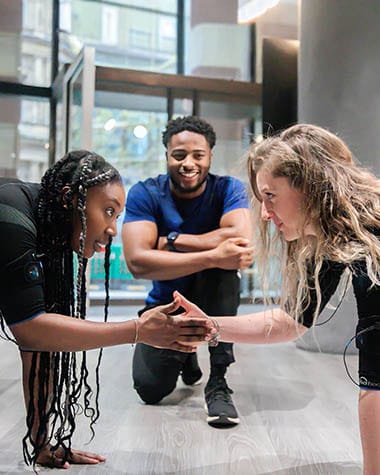
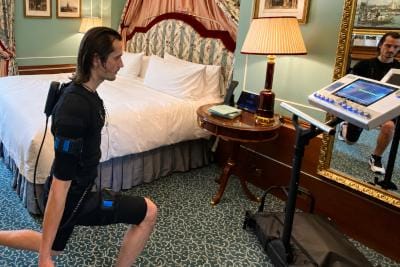
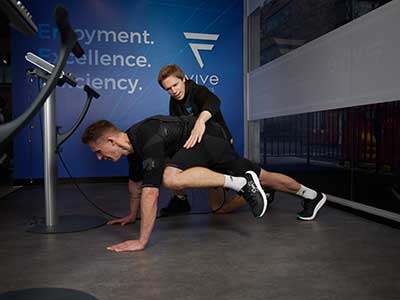
EMS stands for Electro Muscle Stimulation. During a session, you wear a specialist suit fitted with electrodes positioned over the major muscle groups of your body. The suit delivers low-frequency electrical impulses directly to those muscles while you perform guided functional movements, squats, lunges, rows, core exercises.
Under normal conditions, your central nervous system controls muscle contraction by sending electrical signals from your brain, through your spinal cord, to the motor neurons of your muscles. EMS effectively replicates that signal from the outside, bypassing the central nervous system’s usual recruitment sequence and triggering muscle contractions directly.
The key word there is recruitment sequence. This is where the time-efficiency advantage originates and it is worth understanding properly.
Why your brain recruits muscles inefficiently
When you lift a weight or perform an exercise voluntarily, your brain recruits muscle fibres in a strict order: the smaller, less powerful slow-twitch fibres first, with the larger, more powerful fast-twitch fibres only brought in when the effort level demands it. At moderate training intensities, which account for the majority of most people’s gym sessions, the fast-twitch fibres that drive genuine strength and hypertrophy gains are barely recruited at all.
You would need to lift very heavy loads or train close to muscular failure to engage the full spectrum of available muscle fibres through voluntary contraction. Most people, most of the time, do not do this.
EMS bypasses this system entirely. The electrical impulse activates fast and slow-twitch fibres simultaneously, across multiple muscle groups at once, regardless of the external load you are lifting. The result is a far higher proportion of your available muscle tissue receiving a genuine training stimulus, from the very first second of the session.
90% Muscle fibres activated by EMS simultaneously. 30–40%Typical fibre activation in conventional exercise. 20 min Duration of a full Vive Fitness EMS session
What the Research Actually Says
The 20-vs-90-minute comparison is not a marketing invention. It is derived from a body of peer-reviewed research comparing whole-body EMS with conventional resistance training. Here is what the evidence shows.
Key Findings from Published Research
A study published in the Journal of Strength and Conditioning Research compared whole-body EMS training with conventional resistance training in trained individuals over 16 weeks. The EMS group trained for 20 minutes, twice per week. The conventional group followed a standard three-day resistance training programme. Both groups achieved comparable gains in maximum strength, muscle cross-sectional area, and improvements in body composition, with the EMS group training for a fraction of the total weekly time.
A further meta-analysis reviewing multiple whole-body EMS studies found consistent evidence of improvements in maximum strength, power output, and body composition across participant groups ranging from sedentary individuals to trained athletes. The authors concluded that whole-body EMS represents a time-efficient training modality capable of producing adaptations comparable to conventional resistance training.
Research examining the EPOC (Excess Post-exercise Oxygen Consumption) effect from EMS sessions has also found elevated metabolic rate lasting several hours after training, contributing to calorie burn well beyond the session itself a further efficiency advantage for those managing body composition.
It is important to note that these studies assess the overall training stimulus and its outcomes not a direct minute-by-minute calorie-burn equivalence. The claim is about what the physiology achieves, not a stopwatch comparison. In those terms, the evidence is consistent and credible.
Where the comparison has limits
Good science also means acknowledging what EMS cannot do. Some studies comparing EMS with high-volume, sport-specific conventional training programmes have found that traditional methods can produce greater results in certain domains particularly for highly trained athletes working at advanced loads, or for sports requiring very specific movement patterns.
EMS also does not provide meaningful cardiovascular training. A 20-minute EMS session will not replace the benefits of sustained aerobic exercise for cardiovascular health, endurance, or aerobic capacity. And like any training method, results depend heavily on consistency, intensity, nutrition, and recovery.
The most accurate way to understand EMS is not as a shortcut, but as a different kind of tool one that compresses the strength and conditioning stimulus into a smaller time window with exceptional precision.
EMS vs Conventional Training: A Direct Comparison
To make the comparison concrete, here is how a typical 20-minute EMS session at Vive Fitness stacks up against a 90-minute conventional gym session across the factors that matter most for strength, body composition, and health:
| Factor | 20-Min EMS Session | 90-Min Conventional Gym |
|---|---|---|
| Muscle Fibre Activation | Up to 90% simultaneously, incl. deep stabilisers | 30–40% typical; deeper fibres only at high intensity |
| Muscle Groups Trained | Full body all major groups at once | Usually 2–4 groups depending on split |
| Joint Stress | Very low no heavy external loading required | Moderate to high depending on exercises chosen |
| Expert Supervision | 1-to-1 or 1-to-2 with qualified trainer every session | Typically none unless paying for PT separately |
| Total Time Investment | ~45 mins door-to-door including changing | 2+ hours including travel, changing, warm-up |
| Post-Session Calorie Burn | Elevated EPOC lasting several hours | Elevated EPOC, typically shorter duration |
| Cardiovascular Benefit | Limited direct cardiovascular training | High if cardio is included in session |
| Strength & Hypertrophy Outcomes | Comparable to conventional training per research | Comparable, but requires greater time commitment |
When Does 20 Minutes of EMS Equal 90 Minutes and When Doesn’t It?
The comparison holds most strongly under specific conditions. Understanding these helps you get the most from your EMS programme and set realistic expectations.
When It Holds Strongly
Sessions are guided by a qualified trainer who calibrates intensity to your physiology. You train consistently at least once per week. Your nutrition supports muscle repair and recovery. Your goal is strength, body composition, or general conditioning.
When It Holds Less Strongly
Sessions are done at low intensity without proper calibration. You train irregularly. Your goal is primarily cardiovascular fitness or sport-specific endurance. You are an advanced competitive athlete requiring very high training volumes.
Where EMS Consistently Outperforms
Time efficiency for busy professionals. Accessibility for those with joint conditions or injuries. Engaging the deep stabilising muscles that conventional training misses. Delivering expert-guided training without spending hours in a gym.
Where Conventional Training May Have an Edge
Sustained cardiovascular training. Sport-specific movement patterns under load. Very high-volume strength programmes for competitive athletes. Training that requires significant equipment variety (e.g. sport-specific plyometrics).
How Vive Fitness Maximises the EMS Advantage
The efficiency claim depends entirely on the quality of the session. EMS at low intensity with no trainer guidance is a very different experience from EMS at correctly calibrated intensity under expert supervision. This is why the Vive Fitness approach is built around maximising every one of those 20 minutes.
What Every Vive Fitness EMS Session Includes
- A full consultation before your first session goals, medical history, current fitness level so the trainer calibrates your suit settings precisely.
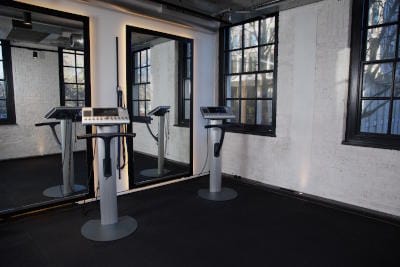
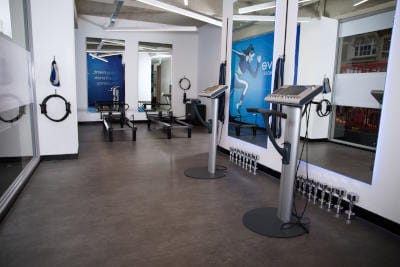
- Miha Bodytec EMS systems, German-engineered to clinical standards and used by elite sports teams worldwide. Not all EMS equipment is equal.
- A qualified personal trainer present for every minute of every session, adjusting intensity in real time and coaching form and effort throughout.
- A structured movement programme, squats, lunges, rows, core exercises chosen to engage all major muscle groups within the session.
- Post-session guidance on recovery, nutrition, and next steps to ensure the training stimulus translates into measurable progress.
- 1-to-1 or 1-to-2 formats never crowded group classes where individual attention and calibration are impossible.
This combination the right technology, the right supervision, the right programme design is what makes the 20-vs-90 comparison realistic rather than aspirational. An uncalibrated suit and no trainer cannot deliver the same result. A calibrated suit and an expert who knows your body can.
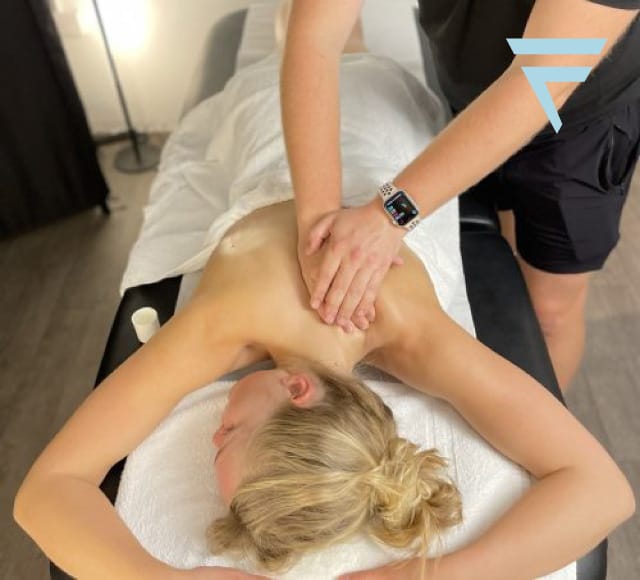
Vive Fitness also offers complementary services that extend the benefits of EMS training: Reformer Pilates for posture and deep core strength, Assisted Stretching for flexibility and recovery, and Sports Massage for circulation and tissue recovery between sessions. For clients whose goal is total body transformation, combining EMS with one of these services each week is the most efficient programme available in London.
What to Realistically Expect: Results Over Time
Results from EMS training are not instantaneous but they arrive considerably faster than most conventional programmes, and they are well documented. Here is an honest timeline based on what Vive Fitness clients typically experience:
Sessions 1–3. The body adapts to the novel stimulus. You will likely feel a deep, broad muscular fatigue unlike anything conventional training produces a sign that the full spectrum of muscle fibres is being engaged. Many clients notice improved posture and core engagement within the first week.
Sessions 4–8. Visible muscle tone typically begins to emerge. Energy levels improve. Several Vive Fitness clients report the disappearance of chronic back pain during this phase, as the deep stabilising muscles around the spine strengthen for the first time.
Sessions 9–16. Measurable improvements in strength, body composition, and endurance become consistent. Research suggests this is the window where EMS results most closely parallel what longer conventional programmes achieve compressed into a fraction of the training hours.
Beyond 16 sessions. Long-term members continue to make progress. Unlike conventional training, where adaptation to a fixed programme eventually plateaus, EMS intensity can be continuously increased as strength grows, maintaining the progressive overload that drives ongoing change.
The Vive Fitness team also offers nutrition guidance as a standalone or complementary service because no training method, however efficient, outworks a diet that actively undermines it.
Frequently Asked Questions
Can 20 minutes of EMS really equal 90 minutes of gym training?
In terms of the physiological training stimulus delivered to your muscles, yes under the right conditions. EMS activates up to 90% of your muscle fibres simultaneously, compared to around 30–40% during conventional exercise. Published research shows EMS can produce comparable gains in strength and muscle mass to conventional resistance training in significantly less time. The comparison is most accurate when sessions are guided by a qualified trainer at the correct intensity and supported by appropriate nutrition and recovery.
How does EMS activate more muscle fibres than conventional training?
During conventional exercise, your central nervous system recruits muscle fibres progressively smaller, less powerful fibres first, with the stronger, deeper fibres only engaged when effort demands it. EMS bypasses this process by delivering electrical impulses directly to motor neurons, forcing simultaneous contraction across multiple muscle groups including the deep stabilising fibres that are very difficult to engage through voluntary effort alone. This is why EMS creates such a high training stimulus in a short time.
What does the research say about EMS versus conventional training?
Multiple peer-reviewed studies have compared whole-body EMS with conventional resistance training. Research published in the Journal of Strength and Conditioning Research found EMS produced comparable improvements in strength, muscle thickness, and body composition to conventional training while requiring significantly less training time. A meta-analysis of whole-body EMS studies found consistent evidence of improvements in maximum strength, power output, and body composition. These findings support the claim that EMS is a highly time-efficient training method.
Is EMS training suitable for beginners?
Yes. EMS is well-suited to beginners because the intensity is fully adjustable and every session is guided one-to-one by a qualified trainer. No prior gym experience is needed. At Vive Fitness, every first session includes a full consultation where the trainer assesses your starting point and calibrates the session to your individual physiology. The low-impact nature of EMS also makes it accessible for people returning from injury or those who find conventional gym training difficult.
How quickly will I see results from EMS training?
Many Vive Fitness clients notice improved muscle tone, energy levels, and posture within four to six weeks of regular EMS training. Meaningful improvements in strength and muscle composition are typically measurable after six to twelve sessions. Speed of results depends on starting fitness level, training frequency, diet, and consistency. One well-calibrated EMS session per week, supported by good nutrition, is sufficient for most clients to achieve progressive results.
Does EMS replace all other forms of exercise?
EMS is a powerful tool for strength, conditioning, and body composition, but it does not replace all forms of physical activity. It does not provide significant cardiovascular training, and results are best when supported by good nutrition, adequate recovery, and in some cases complementary activities such as Reformer Pilates or Assisted Stretching. At Vive Fitness, trainers design programmes that use EMS as the core strength stimulus, with other services available to round out a complete fitness approach.
How often should I train with EMS?
Most EMS protocols recommend one to two sessions per week. Because EMS creates a high training stimulus across all major muscle groups simultaneously, the body benefits from 48 to 72 hours of recovery between sessions. At Vive Fitness, your trainer will advise on optimal frequency based on your goals, current fitness level, and lifestyle. For most clients, one well-calibrated session per week drives consistent, progressive results over time.