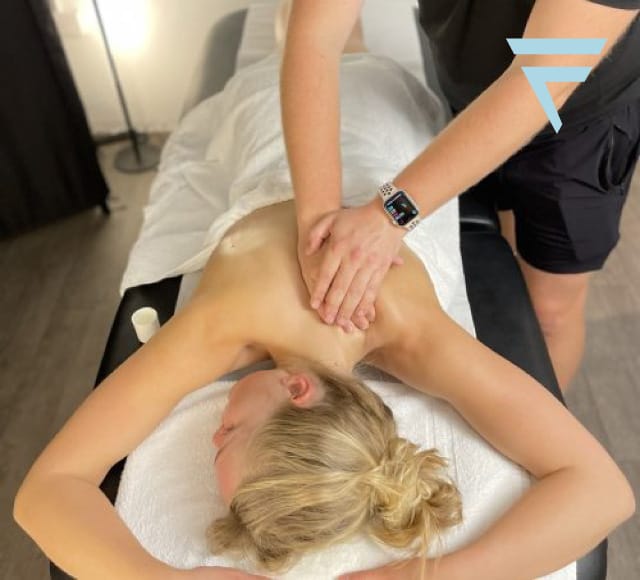

Yes. Physiotherapists can use electrical muscle stimulation (EMS) to help a specific muscle contract during rehabilitation. One well-studied example is strengthening the thigh after a total knee replacement. Whole-body EMS personal training serves a different purpose. It can be an option when you’re ready to return to general exercise and your clinician agrees that this type of training suits you.
If you’ve been away from exercise, the distinction matters. You might still need help straightening your knee, or you might already be walking comfortably and wondering how to build strength again. Those are different starting points, even if the same injury brought you to both.
How does electrical muscle stimulation work in physiotherapy?
Imagine trying to tighten the muscle at the front of your thigh. You know the movement, but after knee surgery it can be surprisingly difficult to produce a strong contraction. A physiotherapist may place electrodes on the skin over the thigh and use electrical pulses to help the quadriceps contract. The clinical term is neuromuscular electrical stimulation, usually shortened to NMES.
The therapist chooses the muscle and adjusts the stimulation around a particular goal. For someone recovering from knee surgery, that goal might be to regain the thigh strength needed to stand up from a chair and walk more comfortably. The exercises and walking practice in their rehabilitation programme give them opportunities to use that strength in everyday movement.
What does the evidence say about EMS after knee surgery?
The American Physical Therapy Association’s 2026 guideline recommends that physiotherapists use targeted quadriceps NMES early after total knee replacement. The outcomes behind that recommendation include better thigh strength, walking performance and the ability to carry out physical tasks. Read the clinical practice guideline on total knee replacement rehabilitation.
If you’re recovering from an operation, a useful question for your physiotherapist is: “Would stimulation help the particular movement I’m struggling with?” A recommendation to use electrodes on one thigh after a knee replacement doesn’t tell you when a whole-body EMS session would suit you after a knee, ankle or shoulder injury. Ask your clinician specifically about whole-body training before booking.
Where does whole-body EMS fit into a return to exercise?
At Vive Fitness, our 20-minute EMS personal training sessions combine guided movements with electrical stimulation delivered through a wearable suit. Several muscle groups can work during the same exercise. You take an active part in each movement, and your trainer can adjust the stimulation as you go. Explore EMS personal training at Vive Fitness.
One attraction after time away is that you can practise bodyweight movements without picking up a heavy dumbbell. For example, if your physiotherapist has cleared you for whole-body EMS and comfortable bodyweight squats, you can tell your trainer what depth you’ve been practising. They then have a practical starting point for the session. If you’re still working towards putting weight through the leg, take that question back to your physiotherapist first.
A short workout can still ask a lot of your muscles. International guidance on whole-body EMS emphasises screening, close supervision and a gradual introduction, even for people who are already fit. If you trained regularly before an injury, use your current ability to guide the conversation with your trainer. Read the international guidance on whole-body EMS training.
What should you tell your EMS trainer after an injury?
“I’m cleared for exercise” can mean anything from gentle walking to a full return to sport. A few details make it easier to decide whether a studio session fits where you are now.
- Explain what you can comfortably do today. “I can walk to work, but I’m still using the handrail going downstairs” gives your trainer more to work with than “my knee is better”.
- Share your clinician’s advice. Mention any limits on weight-bearing, lifting or range of movement, and whether you’ve discussed whole-body electrical stimulation specifically.
- Bring one goal that matters to you. Getting up from a low chair, returning to a weekly class or feeling confident in the gym all give the conversation a focus.
- Flag recent changes. If a previously comfortable movement has started to hurt or your joint has swollen again, speak to your clinician before progressing your training.
Frequently asked questions about EMS and injury recovery
Can EMS speed up healing after a sports injury?
A stronger muscle contraction and a healed injury are different outcomes. The evidence for targeted NMES after knee replacement concerns muscle strength and function. It doesn’t establish that a whole-body EMS workout makes a sprained ligament or torn muscle heal faster. Your physiotherapist can help you judge when the injured area is ready for more demanding activity.
How soon after surgery can I start EMS training?
There’s no single timetable for a studio workout after surgery. Your surgical or physiotherapy team can advise you based on the procedure, how recovery is progressing and any restrictions still in place. If a hospital physiotherapist has already used NMES with you, explain that you’re now asking about exercising in a whole-body EMS suit.
Can I use EMS if I’ve simply fallen out of my exercise routine?
If a busy few months have disrupted your routine and you’re otherwise well, the conversation can start with your fitness goals. Tell your trainer how long you’ve been away, what activity you currently do and what you’d like to get back to. A supervised session gives you the opportunity to try the movements and describe how the stimulation feels while the trainer adjusts it.
Returning to exercise with Vive Fitness in London
We offer one-to-one EMS personal training at our Westminster, Mayfair and Richmond studios. If you’re ready to exercise again but unsure what a first session would involve, tell us which studio suits you, what you’d like to get back to and any guidance you’ve had from your physiotherapist. We can talk through the session with you before you book.
Contact the Vive Fitness team about returning to EMS training.