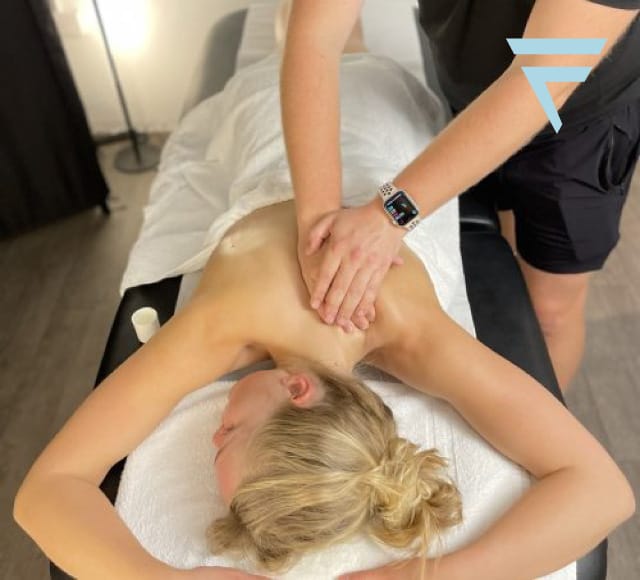

Think about the last time you tried to stretch the front of your thigh. How much of your attention went into the stretch, and how much went into balancing on one leg and trying to catch your foot? In an assisted stretching session, someone supports the movement. You can pay attention to where you feel the stretch and say when it feels right.
The clearest benefit of regular stretching is improved flexibility. One-to-one stretch therapy also gives you a chance to explore movements you find awkward on your own, get feedback as you go and build a routine around something you actually want to do. At Vive Fitness, we offer assisted stretching at our Westminster and Richmond studios in London. Explore assisted stretching at Vive Fitness.
What is assisted stretch therapy?
Assisted stretch therapy is a guided session in which a practitioner supports part of your body and helps you move into a stretch. Take a hamstring stretch as an example. Lying on your back, you can let the practitioner support the weight of your leg as they gradually raise it. You can ask them to pause, bend the knee a little or ease back.
That conversation is part of the session. If you feel the stretch behind your knee when you expected to feel it in the back of your thigh, say so. It gives the practitioner a reason to adjust the position and check how the movement feels to you.
Ten benefits of stretch therapy
1. Improve flexibility over time
Flexibility describes how far a joint can move. A large review of stretching studies found that people who stretched regularly over periods of at least two weeks generally increased their range of motion. The review looked at several kinds of stretching, so its findings support regular practice, including stretches you can do at home. Read the research on stretching and range of motion.
What counts as progress depends on what matters to you. If you enjoy Pilates, it might be finding a more comfortable starting position with your legs extended. If you spend time on the floor playing with your children, it might be finding it easier to sit there with them. Pick a movement you care about and revisit it occasionally. That usually tells you more than comparing how close you and someone else can get to touching your toes.
2. Get comfortable in stretches you usually skip
Some stretches take more coordination than you might expect. Reaching behind you, keeping your balance or holding a strap can become the hardest part. With a practitioner supporting your arm or leg, you have fewer things to juggle. You can ask for a small change in angle and feel the difference immediately.
That can be especially helpful if you’ve repeatedly tried a stretch from a video and never quite understood what you were supposed to feel. Bring that example to your appointment. It gives you and your practitioner a specific question to work on together.
3. Tailor the session to your day and your activities
A runner who spends weekends in Richmond Park may want to explore movement through the calves and ankles. Someone who cycles to work might be more interested in how their hips feel after the ride. Even if you both arrive saying you feel “tight”, the same sequence of stretches may hold little appeal for either of you.
Try starting with an observation. “My shoulders feel stiff when I pull on my coat after work” tells us more than “I need a full-body stretch”. You can use that everyday movement as a reference when deciding where to spend your session.
4. Make a little room to unwind
Some people simply enjoy having a quiet appointment where they can move slowly. When someone else supports your leg and guides the pace, you can notice whether you’re clenching your jaw, gripping the edge of the bench or holding your breath. You can ask to stay in a comfortable position for a moment longer.
If most of your exercise comes with a distance, a weight or a time to beat, that change of pace can be a pleasure in itself.
5. Build a stretching habit you can keep
Stretching is easy to drop when the working day runs late or the last train home is approaching. A booked appointment gives it a place in your week. It can also help you work out what’s worth doing between visits.
Before you leave, ask which stretch you could comfortably repeat on your own. One familiar movement that fits into your evening is a more realistic starting point than trying to remember an entire session. At your next appointment, you can explain what worked and what felt awkward.
6. Notice habits you might miss on your own
When you reach overhead, do you lift your shoulder or arch your back before your arm has travelled very far? It can be difficult to notice while you’re concentrating on the reach. A practitioner can point out what they see and invite you to try the movement again with a small adjustment. You get to feel what changed for yourself.
7. Learn how much stretch feels right for you
If you’ve always assumed a stronger pull means a better stretch, a guided session gives you a chance to experiment. Ask the practitioner to ease back slightly. Can you still feel the stretch while breathing easily and keeping the rest of your body comfortable? Remembering that sensation gives you a reference point the next time you stretch at home.
8. Discover alternatives to getting down on the floor
A floor routine can be inconvenient if kneeling is uncomfortable or there’s barely room to unroll a mat at home. Bring up the position you struggle with. For example, you could ask to try a supported calf stretch standing at a wall. Going home with an option you can do in your work clothes can make a stretch much easier to use.
9. Compare how your left and right sides move
Perhaps you can cross one ankle over the opposite knee easily to tie your shoe, but doing it on the other side takes a little manoeuvring. Trying the same supported position on each side gives you time to notice where the movement feels different. You can adjust each stretch independently without having to make both sides reach the same point.
10. See progress in a movement that matters to you
At your first appointment, choose something you’d like to revisit, such as reaching up to the shelf where you keep your favourite mug. Describe how it feels now. After a few weeks of practice, try it again under similar conditions. Whether the reach feels easier, feels the same or still catches at one point gives you something concrete to discuss at your next visit.
What should a stretch feel like?
Aim for a gentle pulling sensation you can breathe through comfortably. Tell your practitioner if you want less pressure or if anything feels sharp, painful or causes tingling. There’s no advantage to staying silent while someone moves your limb further than you’d like. If a new injury or unexplained persistent pain has prompted you to book, speak to a physiotherapist or another appropriate clinician first.
Questions about stretch therapy
Do I need to be flexible before my first session?
No. You can start with the movement available to you today. If you struggle to sit comfortably with your legs straight or have always found a particular stretch awkward, mention it at the beginning. It gives the practitioner a place to start.
Is assisted stretching different from sports massage?
Yes. In assisted stretching, the practitioner guides a limb or joint through a movement. Sports massage involves hands-on pressure applied to soft tissues. If your main aim is to explore your flexibility and practise moving comfortably through a particular range, assisted stretching is the closer fit.
How often should I book stretch therapy?
It depends on your goal, your diary and what you’re happy to practise independently. If you’re curious about the experience, start with one appointment. If improving flexibility is your aim, discuss how to build regular stretching into your week and agree on a movement you can use to notice progress.
Try assisted stretching in Westminster or Richmond
Our Westminster studio at 22 Medway Street, SW1P 2BA, is within reach of Victoria and Westminster stations. Our Richmond studio at 1 Bridge Street, TW9 1TQ, is by the riverside, convenient if you’re coming across Richmond Bridge from Twickenham.
When you book, tell us one thing you’d like to feel easier, whether that’s reaching overhead, getting comfortable on the floor or stretching after a run. We can start there. Book your one-to-one assisted stretch at Vive Fitness.