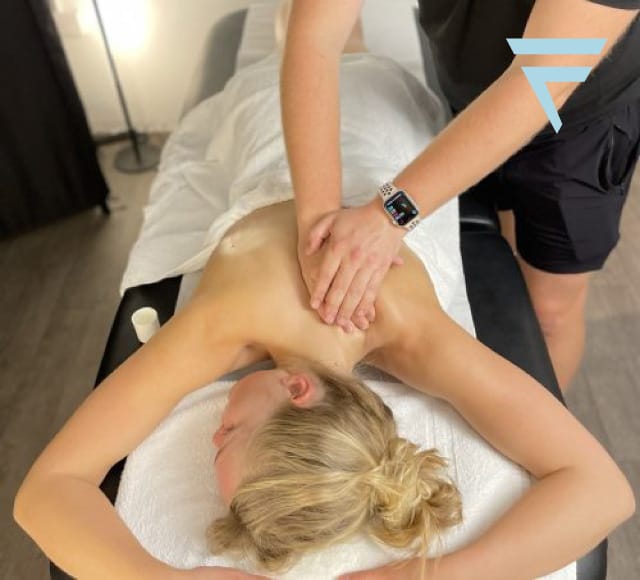

An evidence-aware guide to combining targeted recovery work with strength, control and mobility training at Vive Fitness.
Training creates the stimulus. Recovery helps you return ready to move well. Learn how sports massage can complement EMS and Reformer Pilates without overstating what massage can do.
A good training plan is not only about what happens during a workout. It is also about how well you recover, how comfortably you move and whether you can train consistently from one week to the next. That is where sports massage can fit alongside EMS training and Reformer Pilates.
EMS and Reformer Pilates challenge the body in different but complementary ways. EMS uses electrical impulses alongside guided exercise to create strong muscle contractions across several major muscle groups. Reformer Pilates uses spring resistance, a moving carriage and precise coaching to develop strength, control, stability and mobility. Sports massage does not reproduce either training effect. Instead, it may help manage some of the soreness, stiffness or muscular tension that can build around a regular programme.
The result is not a shortcut to fitness. It is a joined-up approach in which training provides the stimulus and recovery supports your ability to keep moving well.
What is sports massage?
Sports massage is a targeted form of soft-tissue treatment. A session is usually shaped around your activity, current symptoms and the areas that feel restricted or overloaded. Despite the name, it is not only for competitive athletes. It can be useful for people who train for health, spend long hours at a desk, return to exercise after a break or simply want help managing the physical demands of an active week.
Techniques and pressure should be adapted to the individual. Some sessions may focus on broad, comfortable work to reduce the feeling of tightness. Others may spend more time on particular areas such as the calves, glutes, hips, back or shoulders. A good consultation matters because the right approach after a demanding EMS session may be different from the approach used before a gentle Reformer Pilates workout.
What does the research say about sports massage and recovery?
The most useful way to understand the evidence is to separate recovery from performance. A 2020 systematic review and meta-analysis found no evidence that sports massage directly improves strength, sprinting, endurance or other performance measures. It did, however, find small improvements in flexibility and delayed-onset muscle soreness, often called DOMS. A broader review of post-exercise recovery methods also found that massage can reduce perceived soreness and fatigue after demanding exercise.
That distinction is important. Sports massage should not be marketed as something that makes a person stronger by itself, repairs every injury or guarantees better results. Its value is more practical. If a session leaves you feeling less sore, more comfortable and more confident in your movement, it may be easier to maintain good-quality training and everyday activity.
How sports massage can complement EMS training
Whole-body EMS is time-efficient, but short does not mean effortless. Electrical stimulation is applied while you perform trainer-guided movements, so several muscle groups can be working at the same time. International expert guidance describes whole-body EMS as a method with substantial metabolic and musculoskeletal demands. It also emphasises qualified supervision, gradual progression for new users, appropriate hydration and sufficient recovery between sessions.
Sports massage may complement EMS training in several ways:
- Managing post-session soreness. If you experience ordinary training-related DOMS, targeted massage may reduce the perception of soreness while your body adapts to the programme.
- Easing the feeling of muscular tension. EMS can involve the legs, glutes, trunk, back and upper body within one session. Massage can focus on the areas that feel particularly loaded rather than treating every region with the same pressure.
- Supporting comfortable range of motion. Small, short-term improvements in flexibility may help you feel freer when you return to squats, lunges, rotations and other guided EMS movements.
- Creating a useful recovery check-in. A therapist can ask where you feel normal muscular fatigue and where you feel sharper, unusual or persistent symptoms that may need a trainer, physiotherapist or doctor to assess.
Massage does not cancel out the need for recovery. If your trainer recommends more time before the next EMS session, a massage is not a reason to train sooner. Sleep, nutrition, hydration and sensible scheduling remain central to recovery.
How sports massage can complement Reformer Pilates
Reformer Pilates is often described as low impact, but it can still be challenging. Springs create resistance, the carriage demands control and unfamiliar movement patterns can load muscles in new ways. Depending on the session, you may notice work in the deep trunk muscles, glutes, hips, inner thighs, calves, shoulders or upper back.
Sports massage and Reformer Pilates can work well together because they address different parts of the movement picture. Pilates develops active control. You learn to create force, stabilise joints, coordinate breathing and move with precision. Massage is passive. It may reduce the feeling of soft-tissue tension or soreness, but it does not teach control or build lasting strength on its own.
For example, a client who feels tight through the hips may find massage makes movement feel more comfortable in the short term. Their Reformer Pilates sessions can then focus on the strength, pelvic control and movement habits needed to use that range well. Similarly, someone who carries desk-related tension through the shoulders may use massage for symptom relief while Pilates develops upper-back endurance, shoulder control and trunk stability.
When should you schedule sports massage around training?
There is no single timetable that suits everyone. Pressure, duration, training experience and sensitivity all matter. The following principles provide a sensible starting point:
- Before training: keep the treatment lighter and focused on comfort or mobility. A vigorous deep-tissue session immediately before hard training may leave some people tender or temporarily fatigued.
- After training: a comfortable recovery-focused session may suit some clients. If you prefer deeper work, scheduling it on a separate recovery day gives you time to notice how your body responds.
- During a heavy training week: place massage away from your most demanding EMS session or technical Reformer Pilates workout if deep pressure usually makes you sore.
- When starting EMS: follow your trainer’s progression and recovery guidance. New users should not use massage as a way to override sensible gaps between sessions.
Communication is the most important part. Tell your massage therapist what training you completed, when you completed it, what intensity you used and what you plan to do next. Also tell your trainer if a massage has left an area tender so the next session can be adjusted.
A simple way to combine all three services
A balanced week might place the services in this order:
- EMS training to provide a time-efficient full-body strength stimulus.
- A recovery day with walking, hydration, regular meals and sleep.
- Sports massage if soreness or tension is affecting comfort, with pressure matched to your response and upcoming training.
- Reformer Pilates later in the week to develop control, core stability, mobility and movement quality.
This is only an example, not a prescription. Some people will prefer Reformer Pilates before EMS. Others may benefit from massage every few weeks rather than every week. Your training history, goals, symptoms and schedule should determine the plan. The advantage of a personalised service is that the programme can change as your body adapts.
Sports massage, normal soreness and possible injury
Normal post-exercise soreness is usually a dull ache or stiffness that appears after unfamiliar or demanding activity and improves over several days. Sharp pain, sudden weakness, marked swelling, severe bruising, numbness, chest pain, fever or pain that is worsening rather than settling should not be treated as ordinary DOMS.
Do not book massage as a substitute for diagnosis. Tell the therapist before treatment if you have a recent injury or operation, skin infection, fever, unexplained swelling, a history or risk of blood clots, a bleeding disorder, severe osteoporosis, pregnancy, a medical condition or medication that affects treatment. If symptoms are acute, severe or unusual, seek advice from an appropriate healthcare professional first.
Why personalisation matters
The strongest connection between sports massage, EMS and Reformer Pilates is not a particular technique. It is communication. Your EMS trainer can note which movements and muscle groups were challenged. Your Reformer Pilates coach can identify where control or mobility is limiting a movement. Your massage therapist can then use that information to shape a more relevant recovery session.
This approach also prevents a common mistake: treating every sensation as something that needs to be released. Some stiffness is a normal response to training, and some movement limitations are better addressed through gradual strength and skill development. Massage is most useful when it supports the programme rather than replacing the work that produces adaptation.
The bottom line
Sports massage complements EMS and Reformer Pilates by supporting the space between sessions. It may help reduce delayed-onset muscle soreness, improve short-term flexibility, ease the feeling of tension and make recovery feel more manageable. EMS supplies a concentrated strength stimulus. Reformer Pilates develops control, stability and mobility. Massage can help you return to both feeling more comfortable and ready to focus.
For the best results, keep expectations realistic and make the plan personal. Use massage as one part of recovery, alongside sleep, food, hydration, rest and well-paced training. If pain is unusual or persistent, pause and get it assessed rather than trying to massage through it.
Ready to build a more complete training and recovery plan? Explore Vive Fitness sports massage, EMS and Reformer Pilates services, and ask the team which combination best fits your goals, current training and studio availability. Book or enquire with Vive Fitness.
Frequently asked questions
Is sports massage good after EMS training?
It can be helpful for some people, particularly for the perception of ordinary muscle soreness or tension. The pressure and timing should match how hard you trained and how your body responds. Massage does not replace the recovery interval recommended by your EMS trainer.
Can I have sports massage and Reformer Pilates on the same day?
Yes, in some cases. A lighter massage before Pilates may be appropriate when the goal is comfort or mobility. Deep work may be better after training or on another day if it tends to leave you tender. Tell both practitioners what is scheduled.
Does sports massage improve flexibility?
Research suggests a small short-term improvement in flexibility is possible. Lasting movement capacity still depends on regular mobility work, strength, control and appropriate training.
Will sports massage prevent injuries?
It should not be presented as a guarantee of injury prevention. It may help you notice areas of tension, feel more comfortable and maintain a consistent programme. Good coaching, load management, recovery and timely assessment of symptoms remain more important.
How often should I book sports massage?
Frequency depends on training load, goals, budget and how you respond. Some clients prefer occasional sessions when training volume rises, while others schedule regular recovery appointments. Start with an assessment and review whether each session is producing a useful, measurable benefit.
Sources
- Vive Fitness, Sports Massage
- Vive Fitness, EMS Workouts vs Reformer Pilates
- Davis et al. (2020), Effect of sports massage on performance and recovery: a systematic review and meta-analysis, BMJ Open Sport & Exercise Medicine
- Dupuy et al. (2018), An Evidence-Based Approach for Choosing Post-exercise Recovery Techniques, Frontiers in Physiology
- Dakić et al. (2023), The Effects of Massage Therapy on Sport and Exercise Performance: A Systematic Review, Sports
- Kemmler et al. (2023), Position statement and updated international guideline for safe and effective whole-body electromyostimulation training, Frontiers in Physiology